

Algebra 1 EOC Practice Test: The Complete Preparation Guide
Linear functions — slope-intercept form
Linear equations appear throughout the Algebra 1 EOC, often asking students to identify slope and y-intercept from a graph, or to graph an equation given in y = mx + b form.
A line with slope 2 and y-intercept 1, written in slope-intercept form.
Standardized testing can feel overwhelming, especially when a single exam carries as much weight as the Algebra 1 End-of-Course (EOC) assessment. Whether you’re a student gearing up for test day or a parent looking to support your child’s math journey, understanding how to effectively use an Algebra 1 EOC practice test can make the difference between anxiety and confidence. This guide breaks down everything you need to know — from what the exam covers to how to build an efficient study plan.
What Is the Algebra 1 EOC Exam?
The Algebra 1 End-of-Course exam is a standardized assessment given in many U.S. states to measure student mastery of Algebra 1 content. In states like Florida, Texas, and others that use EOC systems, this exam often plays a significant role in course grades, graduation requirements, or grade-level promotion. Because the stakes are high, students benefit enormously from structured, targeted preparation — and that’s exactly where practice tests come in.
Why Practice Tests Matter
A well-designed Algebra 1 EOC practice test does more than just quiz students on formulas. It serves several critical purposes:
- Familiarizes students with test format. Knowing the structure — multiple choice, gridded response, or technology-enhanced items — reduces surprises on exam day.
- Identifies knowledge gaps. Practice tests reveal which topics need more review, whether that’s linear equations, quadratic functions, or systems of inequalities.
- Builds time-management skills. Timed practice helps students learn to pace themselves so they don’t run out of time on longer problem sets.
- Reduces test anxiety. Repetition and familiarity are proven ways to lower stress, allowing students to perform at their true skill level rather than being hindered by nerves.
Core Topics Covered on the Algebra 1 EOC
While exact content varies by state standards, most Algebra 1 EOC exams assess the following core areas:
- Expressions and Equations – Simplifying expressions, solving linear equations, and working with inequalities.
- Linear Functions – Graphing lines, interpreting slope and intercepts, and writing equations from data or graphs.
- Systems of Equations and Inequalities – Solving systems algebraically and graphically.
- Quadratic Functions – Factoring, graphing parabolas, and solving quadratic equations using multiple methods.
- Exponential Functions – Understanding growth and decay models.
- Polynomials – Operations with polynomials, including addition, subtraction, and multiplication.
- Statistics and Data Interpretation – Analyzing scatter plots, lines of best fit, and correlation.
A strong practice test will mirror this distribution, giving students proportional exposure to each topic based on how heavily it’s weighted on the actual exam.
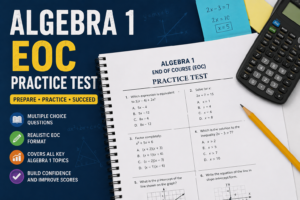
How to Use Practice Tests Effectively
Simply taking a practice test isn’t enough — how you use the results matters just as much. Consider this approach:
1. Take a Diagnostic Test First
Before diving into study guides, complete a full-length practice test under timed conditions. This establishes a baseline and highlights which content areas need the most attention.
2. Review Every Missed Question
Don’t just check the answer key — understand why an answer was wrong. Was it a conceptual misunderstanding, a careless calculation error, or a misread question? Each type of mistake requires a different fix.
3. Study in Focused Blocks
Rather than reviewing everything at once, dedicate short, focused sessions to specific weak areas. For example, spend 20–30 minutes solely on factoring quadratics before moving to a new topic.
4. Retake Practice Tests Periodically
Spacing out practice tests over several weeks (rather than cramming them into a few days) improves long-term retention. Many students benefit from a “test–review–retest” cycle.
5. Simulate Real Testing Conditions
As the actual exam date approaches, take at least one full practice test under realistic conditions — same time limit, no distractions, no notes — to build stamina and confidence.
Tips for Parents and Teachers
Supporting a student through EOC preparation doesn’t require being a math expert. Here’s how adults can help:
- Create a consistent study schedule rather than relying on last-minute cramming.
- Encourage error analysis instead of just tracking scores.
- Provide a distraction-free study environment for practice sessions.
- Celebrate incremental progress, not just perfect scores, to keep motivation high.
Common Mistakes to Avoid
Even motivated students can fall into these traps:
- Memorizing without understanding. Algebra rewards conceptual understanding over rote memorization — formulas mean little without knowing when and why to apply them.
- Skipping word problems. These often carry significant weight and require translating real-world scenarios into equations, a skill that needs deliberate practice.
- Ignoring calculator skills (if calculators are permitted). Knowing how to use a graphing calculator efficiently can save valuable time.
- Neglecting review of “easy” topics. Careless errors on basic problems can cost just as many points as struggling with harder ones.
Final Thoughts
Success on the Algebra 1 EOC exam isn’t about last-minute luck — it’s the result of consistent, strategic practice. Using high-quality practice tests as a diagnostic and reinforcement tool allows students to study smarter, not just harder. By understanding the exam’s structure, focusing on weak areas, and simulating real test conditions, students can walk into their EOC exam with confidence and a genuine command of Algebra 1 concepts.
With the right preparation strategy, the Algebra 1 EOC doesn’t have to be a source of stress — it can be an opportunity to demonstrate real mathematical growth.


